Executive Summary
Traditional change management was designed for linear, fixed-scope software deployments, ERP migrations, CRM overhauls. These projects have defined start dates, fixed go-lives, and stable functionality. Artificial intelligence evolves at an exponential pace. By the time an enterprise completes a traditional 12-month change rollout, the underlying models, agentic capabilities, and workflow integrations have advanced through multiple iterations.
This article explores how organizational leaders can refactor the Prosci Methodology, transitioning it from a static, project-based framework into a continuous, high-velocity change capability that absorbs rapid AI shifts without triggering employee burnout.
The data is sobering. McKinsey's State of AI 2025 report reveals that while 88% of organizations now use AI, barely 6% qualify as "AI high performers", those reporting more than 5% EBIT impact from AI. The gap between adoption and value creation is widening, not shrinking.
Introduction: Why This Blog Exists
If you're reading this, you're likely a leader wrestling with a question that keeps surfacing in boardrooms and strategy offsites: How do we get real value from AI before the technology renders our implementation plan obsolete?
This article inaugurates the blog at agenticprocessvalue.ai/blog: a new space dedicated to one deceptively simple question: how do we convert agentic AI capabilities into measurable business value? Not hype. Not vaporware. Not proof-of-concept graveyards. Actual, auditable return on investment.
The moment calls for this blog. Enterprises are spending billions on AI. Sixty-two percent are experimenting with AI agents (McKinsey, 2025). Yet most organizations are trapped between two worlds: traditional change management designed for ERP rollouts in 2010, and AI capabilities that iterate weekly.
I've spent thirty years navigating technology shifts, from the pre-web era through the internet revolution, mobile, cloud, and now agentic AI. One pattern repeats across every wave: technology adoption fails when the human operating system doesn't upgrade alongside the technical one. This blog exists to bridge that gap.
The promise: every article will connect a real business problem to a concrete, actionable framework, with enough rigor to defend in a boardroom and enough clarity to execute next Monday.
Let's begin with the most fundamental tension of this era: the AI Velocity Gap.
1. The AI Velocity Gap
Every organization attempting AI transformation encounters a fundamental tension. Technology capability compounds exponentially. Human adaptation, habit formation, trust building, cultural norms, advances linearly.
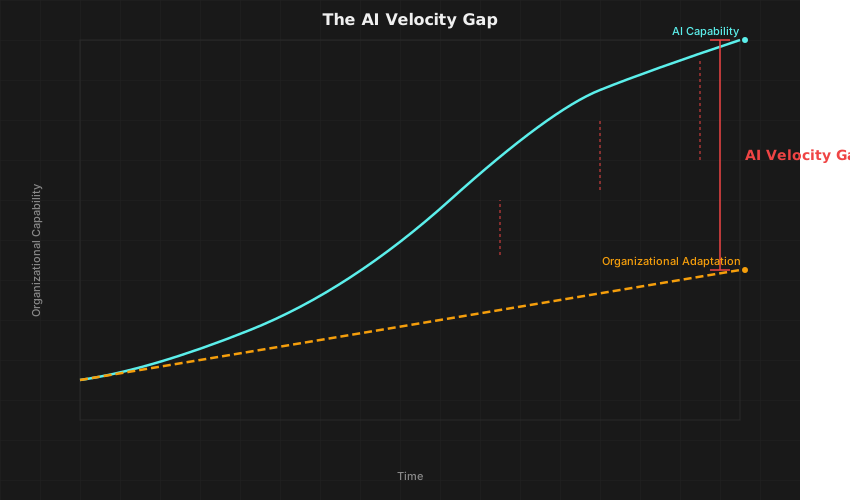
When this gap widens unchecked, three failure modes emerge:
| Failure Mode | What It Looks Like | Root Cause |
|---|---|---|
| Obsolete Training | Curriculum created in month two covers basic prompting; by month six, the enterprise has deployed custom RAG pipelines and autonomous agents | Static content designed for a snapshot of technology, not a moving target |
| Change Fatigue | Employees subjected to endless, disconnected announcements and policy updates. Cynicism and disengagement follow | Fragmented communication with no unifying narrative |
| Adoption Illusion | Central IT reports high seat activation (licensing), but actual depth of usage remains surface-level. Employees use AI for email drafts while core workflows stay untouched | Measuring access, not behavior |
The numbers confirm the pattern. Only 23% of organizations are scaling AI agents beyond pilots (McKinsey, 2025). Nearly two-thirds haven't begun scaling at all. And IBM Watson Health, a $4 billion moonshot meant to revolutionize oncology, was sold for parts in 2022 for roughly $1 billion. The autopsy, documented by STAT News, identified the root cause: not the technology, but the failure to earn clinician trust and integrate into existing clinical workflows. Change management failure, dressed in an AI costume.
The strategic pivot is clear: AI change management is no longer about "implementing Tool X." It's about building organizational muscle for continuous, low-friction adaptation.
2. Re-Architecting Prosci's 3-Phase Process for Continuous Velocity
To match the pace of modern AI, Prosci's 3-Phase Process must evolve from a one-time project lifecycle into a continuous operational loop. Below is the refactored framework. The three phases define what must change. The four pillars (Section 4) detail how to execute.
Phase 1: Prepare Approach → Constructing the Adaptability Foundation
In traditional projects, Phase 1 defines the change strategy for a single deliverable. In a high-velocity AI environment, Phase 1 establishes the infrastructure for continuous change:
-
Continuous Executive Sponsorship: Securing C-suite commitment not just for a specific tool launch, but for an ongoing culture of AI experimentation and workflow redesign. Prosci's own research shows projects with extremely effective sponsors are 79% likely to meet objectives, versus 27% with ineffective sponsors.
-
Agile Governance & Guardrails: Setting clear acceptable-use policies, security boundaries, and data privacy rules early so employees can experiment safely without waiting for case-by-case approvals. The goal is speed within guardrails, not speed or guardrails.
-
Flexible Impact Assessment: Evaluating how AI continuously shifts job profiles and core competencies across business units. This is not a one-time exercise; it's embedded into quarterly business reviews.
Phase 2: Manage Change → Executing Micro-Enablement Cycles
Rather than delivering a massive, single-event training program at go-live, Phase 2 transforms into Micro-Enablement Cycles: short, bi-weekly capability drops:
-
Modular Communications: Replacing long town halls with concise, role-specific video digests highlighting one newly enabled high-value AI workflow per sprint.
-
Sprint-Based Training: Delivering bite-sized learning modules focused on immediate, practical application rather than comprehensive technical theory.
-
Adaptive Manager Coaching: Equipping middle managers with weekly discussion prompts to guide their direct reports through local workflow adjustments. Managers are the single most underleveraged change asset: employees trust their direct supervisor far more than a corporate communications email.
Phase 3: Sustain Outcomes → Operating Real-Time Telemetry Loops
Instead of conducting a single post-implementation review 90 days after launch, Phase 3 becomes a continuous telemetry feedback loop:
-
Active Telemetry Monitoring: Tracking real-time adoption metrics: daily active usage, token consumption patterns, prompt success rates. Spotting adoption drop-offs within days, not quarters.
-
Rapid Friction Remediation: Identifying where employees hit barrier points (poor output accuracy, complex UI integrations) and deploying targeted micro-trainings within 48 hours.
-
The Depreciation Discipline: A critical mechanism absent from traditional change models. As new AI workflows are adopted, leaders must actively archive or deprecate legacy practices. If each micro-cycle adds a new capability without removing an obsolete one, the cognitive load on employees grows monotonically, accelerating change saturation. Schedule a quarterly "sunset review": for every new AI workflow introduced, identify and retire one legacy manual process.
3. The "Layered ADKAR" Model for AI Maturity
An enterprise AI transformation is not a single ADKAR journey. It is a series of stacked ADKAR loops that trigger as organizational AI capability deepens. Each tier introduces a fundamentally different relationship between employee and technology, and therefore demands a distinct ADKAR strategy.
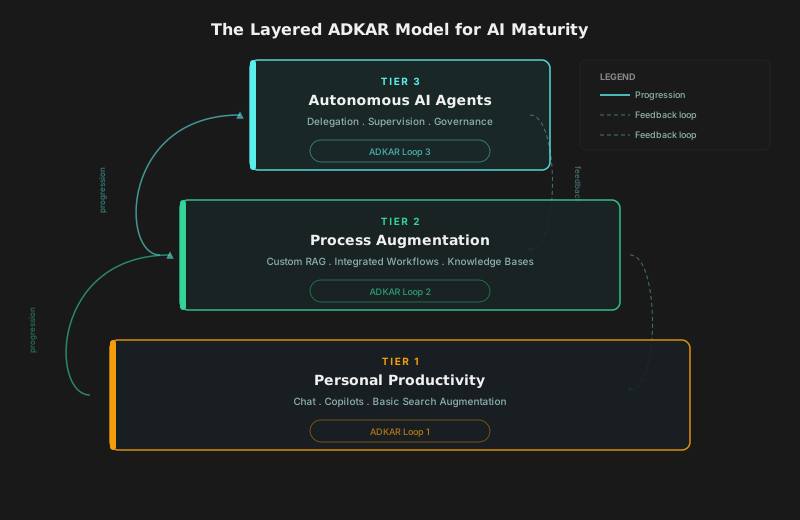
Tier 1: Personal Productivity (Chat & Copilots)
What it is: Individual employees using conversational AI and basic search augmentation for personal tasks: drafting emails, summarizing documents, brainstorming.
ADKAR Priorities: - Awareness & Desire: Overcoming job displacement anxiety. The messaging must shift from "AI will replace you" to "AI will handle the part of your job you dislike most." - Knowledge & Ability: Teaching baseline prompting, context provision, and output verification. Not comprehensive theory; practical muscle memory.
Transition trigger to Tier 2: When employees independently begin asking "Can I connect this to our internal data?" or "Can I automate this recurring task I do weekly?", the shift from personal tool to business process has begun.
Tier 2: Process Augmentation (Custom RAG & Integrated Workflows)
What it is: AI embedded directly into line-of-business applications, enterprise knowledge bases, and team processes. The AI is no longer a separate chat window. It's inside the CRM, the claims system, the inventory dashboard.
ADKAR Priorities: - Desire: Moving from novelty usage to daily habitual workflows. This is where the majority of stalled transformations live. McKinsey found that 62% of organizations are experimenting with agents but only 23% are scaling, the "experimentation trap." - Knowledge: Instilling critical evaluation habits: verification of AI-generated data, recognition of hallucination patterns, understanding the difference between AI confidence and AI accuracy. - Ability: Building muscle memory for AI-augmented workflows until they feel as natural as checking email.
Transition trigger to Tier 3: When the organization has enough Tier 2 proficiency that not having AI assistance feels like a productivity handicap, and when trust in AI outputs has reached the threshold where delegation (not just augmentation) becomes viable.
Tier 3: Autonomous AI Agents (Delegation & Supervision)
What it is: The most profound shift, and the one that justifies this blog's domain name. Employees transition from operating software to supervising autonomous agents that execute multi-step business tasks independently. This is not copiloting; this is delegation with oversight.
ADKAR Priorities: - Awareness: Understanding that "agent" does not mean "employee replacement." The agent handles execution; the human handles judgment, exception handling, and escalation. This distinction is critical. Without it, resistance hardens before the first agent is deployed. - Desire: Managing the fear of losing operational control. This is not the abstract anxiety of Tier 1 ("will AI take my job?"). It's visceral: "If I delegate this claim adjudication to an agent and it makes a $50,000 error, am I responsible?" Addressing this requires clear organizational policy on accountability before agents go live. - Knowledge: Building human-in-the-loop auditing skills. Supervisors must learn to spot agent failure modes: drift, hallucination in structured outputs, edge-case blindness. This is a new professional competency that does not exist in any corporate training catalog today. - Ability: Transitioning cognitive load from doing to evaluating. This is harder than it sounds. An employee who has spent 15 years processing claims manually must learn to scan 50 agent-processed claims in the time they used to handle five, flagging anomalies instead of processing every case. This is a fundamentally different mental model. - Reinforcement: Recognizing employees who successfully scale their output through agent delegation. The reward system must shift from "how many widgets did you produce" to "how effectively did you supervise the agent that produced the widgets." Without this shift, employees optimize for individual output metrics and ignore the agent entirely.
The competency gap: Tier 3 requires skills that no current certification program teaches: agent supervision, audit trail analysis, escalation protocol design, and the ability to distinguish between "the agent made an error" and "the agent encountered a novel situation it was never trained for." Organizations that reach Tier 3 without investing in these human competencies will see agent initiatives fail, not because the agents malfunction, but because the supervisors weren't equipped to supervise.
4. Operationalizing Velocity: 4 Core Execution Pillars
If the refactored Phases define what must change, these four pillars define how to execute: the daily operational mechanics that make continuous velocity sustainable.
Pillar 1: "Mindset First, Tool Second" Training Strategy (80/20 Rule)
Interfaces, vendor names, and model generations change constantly. Foundational cognitive habits endure. Training programs should allocate 20% to which buttons to click and 80% to core AI literacy:
- Problem decomposition: Breaking complex business tasks into modular, delegatable steps
- Context engineering: Providing rich, precise background data to models
- Output verification: Auditing AI work critically; treating AI output as a first draft, not a final answer
Pillar 2: The Embedded "Pacesetter" Network
Central change teams cannot keep pace with localized workflow shifts across every department. By recruiting and training Pacesetters: tech-curious employees embedded directly within business units, organizations decentralize change execution:
- Pacesetters run local micro-ADKAR loops within their teams
- They share real-time wins and flag emerging resistance to leadership immediately
- Critically, they are not "AI Champions." A Pacesetter sets the tempo for adoption, while a Champion advocates. Tempo-setting is operational; advocacy is promotional. The distinction matters.
Pillar 3: Quantitative & Qualitative Telemetry
High-velocity change requires real-time, multi-dimensional data:
| Data Type | Examples | What It Reveals |
|---|---|---|
| Quantitative (Operational) | Weekly active users, prompt volumes, token consumption, execution times | Adoption breadth and surface depth |
| Quantitative (Behavioral) | Workflow completion rates, time-to-task with AI vs. without, AI-assisted decisions per employee | Actual workflow integration (vs. casual use) |
| Qualitative | Weekly 2-minute pulse surveys, Pacesetter feedback channels, manager debriefs | Trust, friction points, emerging resistance themes |
Combine these into a live organizational health dashboard reviewed during weekly leadership standups, not buried in a quarterly PowerPoint.
Pillar 4: Psychological Safety & Sandbox Culture
Fear of making mistakes or leaking data severely stifles AI experimentation. Leaders must create designated sandbox environments where employees can test AI on real business problems without fear of performance penalties or compliance breaches.
A practical mechanism: designate dedicated sandbox sessions within each sprint, where employees explore AI workflows with a simple rule: no output from sandbox sessions enters production without review, and no mistake in the sandbox has career consequences. The data from Prosci is unambiguous: projects with excellent change management are seven times more likely to meet objectives than those with poor change management. Sandboxes are not a "nice to have." They are the mechanism that converts fear into experimentation.
5. The High-Velocity Change Matrix
The table below maps how practitioners adapt classic Prosci activities for continuous AI rollouts. Every dimension shifts from "project" to "operating system."
| Change Dimension | Traditional Prosci (Static Projects) | Prosci Refactored for AI Velocity |
|---|---|---|
| Primary Scope | Fixed software version / single rollout | Evolving AI capabilities & agentic workflows |
| Sponsorship | Coalition active during project execution | Ongoing C-suite commitment to continuous adaptation |
| Training Model | Comprehensive classroom/eLearning pre-go-live | Continuous micro-learning modules & prompt libraries |
| ADKAR Execution | Single, linear path from A to R | Sequential, layered ADKAR loops per AI maturity tier |
| Resistance Management | Reactive intervention during training/go-live | Proactive mitigation via sandbox culture, Pacesetters, and sunset reviews |
| Success Metrics | Go-live on time, on budget, target completion rates | Real-time active usage, workflow depth, self-reported trust, and task efficiency gains |
Where We Go From Here
The AI Velocity Gap is not closing on its own. McKinsey's data confirms the pattern: adoption is soaring, but value creation remains concentrated among a tiny fraction of organizations. The difference between the 6% who capture real EBIT impact and the 88% who simply use AI is not better models. It's better change architecture.
In the next two years, the "AI change manager" role will evolve into something fundamentally different. This person won't manage project timelines. They will orchestrate a nervous system: continuous telemetry, micro-enablement cycles, layered ADKAR loops, and the active depreciation of legacy practices that no longer serve. The job shifts from managing transitions to maintaining an adaptive operating cadence.
Questions, objections, or your own experience with high-velocity AI change? Reach out. This blog will exist to sharpen frameworks through real-world application.
Sources
- McKinsey: The State of AI: Global Survey 2025
- Libertify: State of AI 2025: McKinsey Report (Interactive)
- CXToday: McKinsey State Of AI In 2025: What It Means For CX
- Prosci: The Correlation Between Change Management and Project Success
- Prosci: Change Management Success
- Slate: How IBM's Watson Went From the Future of Health Care to Sold Off for Parts
- Henrico Dolfing: Case Study 20: The $4 Billion AI Failure of IBM Watson for Oncology
- Healthcare Digital: IBM Watson Health Was Once the Future of Healthcare AI: What Exactly Went Wrong?